

Dr. Zaius, what are you up to?
Brunerlot?
Don't get excited...It's just an early morning jet-lag joke. Un'scherzo...

 Rome, Rome, Rome, always the beginning and the end of so many stories. In the recent events, it was the point where we started the circle and finished it.
 The 2008 harvest is underway and in the coming days I’ll be posting notes from what I saw and touched, drank and thought. This year the harvest report centers on Central Italy, with Tuscany and the Maremma on one side and the Marche/Abruzzo on the other, like a teeter-totter between Sangiovese and Montepulciano. Other grapes as well. But we won’t be going off too far into esoterica on this trip, no, this isn’t the time for too much autochthon. This is a time to batten down the hatches and lean out, make it through the present cycle, which is not without its challenges.
 Interesting find in a neighborhood that I like to stay in, Parioli. A little spot called La Balestra on the Via Simeto 2/F. Not on anybody’s radar, no reviews, just a great neighborhood spot with good service, clean food, fantastic wine prices. I will post about it later.
 One story. On the last day, we were about 40 km from the airport, with traffic no more than an hour. I set the GPS for the quickest route, not the shortest (I had learned that the hard way when we went from Castiglione della Pescaia to Firenze, over every last hilltop town).
 Something that’s been bugging me off and on is words to describe things that are taken from another word which has another context. About once a week I get someone in a sales group or wine shop asking me about the different Montepulciano wines, that "noble" one from Tuscany and the “other” one from some region to the east of Tuscany.
 Mary Ewing-Mulligan, Ed McCarthy, the authors of Italian Wine For Dummies, say it best in their book, and I quote, “The confusion is understandable, but these two wines are definitely different wines made from different grape varieties. Vino Nobile is a dry red wine made primarily from the Prugnolo Gentile variety (a type of Sangiovese) around the town of Montepulciano in southeastern Tuscany. Montepulciano d'Abruzzo is also a dry red wine, but made mainly from the Montepulciano variety, which grows in the region of Abruzzo on the Adriatic coast, southeast of Tuscany. The Montepulciano variety is believed to be native to the Abruzzo region, and it has no connection to Sangiovese or to the town of Montepulciano in Tuscany.” That’s as simple and clear an explanation as it gets! Now go and get the book, because there are other nuggets in it.
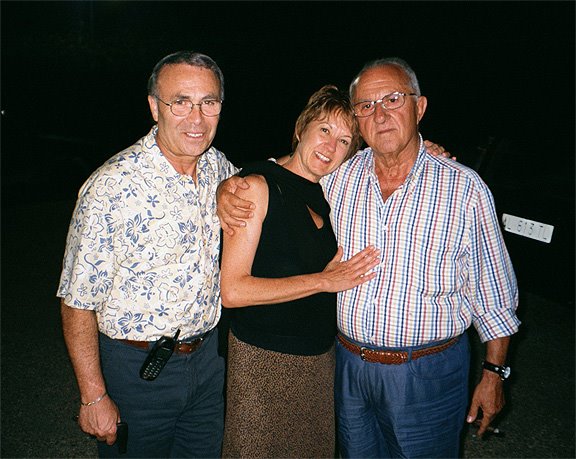 In trips to Italy I have been really fortunate to spend time in the Abruzzo region and make friends with winemakers there.
 There are great memories around the open hearth with vine branches roasting fresh lamb and pork from the macelleria with bottles of Montepulciano d’Abruzzo.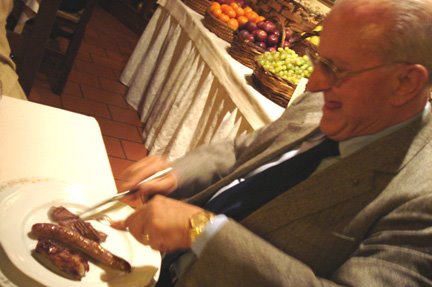


 A short drive to the resort went smoothly enough. A little idle chatter and gossip, nothing to sink the teeth into yet. Lily was a student of music and Marsala, her father was a winemaker, mother an opera singer. We were going to taste some of his older wines along with a few others from some of the luminary winemakers of the region. Marco de Bartoli was up in Bukkuram. Salvatore Murana was harvesting his Zibibbo at Mueggen. Donnafugata’s Ben Ryè was being harvested and taken over to Khamma Fuori. So at once a busy time for some, and a time of relaxation for others. And at night everyone would gather and eat and drink and enjoy each others company.
 Marco de Bartoli Marsala Superiore Dieci Anni- 10 years in big oak barrels with the Solera method. 50% Grillo, 50% Inzolia
 Donnafugata’s "Ben Ryè" 2004 Passito di Pantelleria
 Why do we eat out? That was the question I was asking myself today at lunch. I was in a little Italian-styled restaurant where we had convinced the owners to do a progressive wine list. Unfortunately they hired a manager, still wet behind the ears, who thinks he knows better. “The people can’t find the wines they are looking for; we need to make it easy for them.” We were – by arranging the wines in the order of their styles so they wouldn’t have to depend on the constant turn of wait staff and managers who have no real life experience in these matters.
 The Italians have been wonderful for all of us. Who would have thought a simple plate of pasta would give so much pleasure day after day, throughout the generations? A little flour, an egg, some water. A little tomato or maybe some porcini. And cheese, my heroin.
 Not just the Italians though. One day on a Good Friday in Frankfurt, we happened to walk by their Wall Street, the Börse. Outside, tents had been erected and impromptu wine bars were pouring Riesling and Muller-Thurgau to the businessmen and women. What a grand revelation – the leaders of business for one of the strongest industrial and economic powers, lollygagging outside, talking to each other on the eve of a holiday. Drinking wine, not making money. How civilized, I mused, how very wonderful.
 The fabulous city of slow food, Eataly, in Torino. Table after table of the different stages of eating, with people, families, sitting together, enjoying prosciutto or gelato. The table, always the table.
 A picnic in Perigord. A visit to the farmers market and a wine shop or two. A roasted chicken, some potatoes, and green beans. And red wine from Cahor. A light breeze through the trees that were shading and cooling us, and people we just met were strangers no more. Today one of the couples emailed me from New York. They were at Babbo and were wondering about a Traminer on the list. Not some traditional, tired wine list. They had their hands on a list with spunk, with balls. For lovers and fighters, with passion and purpose.
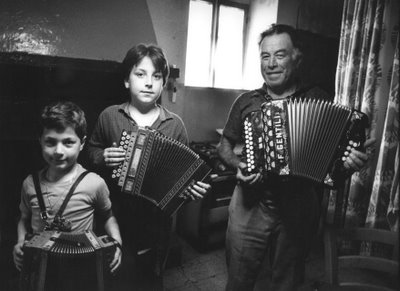 This week I have been immersed in Piedmont. Barolo, Castiglione Falletto, Serralunga, Cuneo, Barbaresco and on. Sorting out some information for the young sales force. This link between humans and the land that makes one wine taste one way and another, over on a hill 2 miles away, taste another way. The Italian wine trail ends today in the Langhe, but starts in the Marche.
 There are other occurrences. Italy is rampant with them.
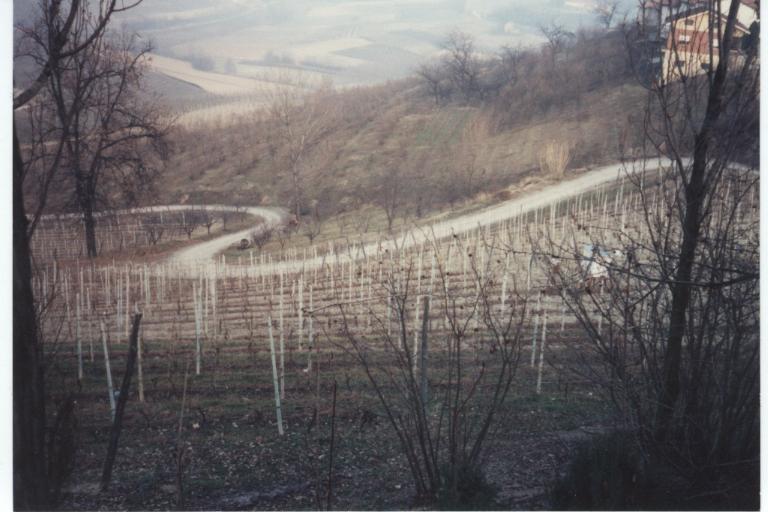 vineyard that would be ready in a five or so years. Five years! We’ve gone through a mate or two, two cars, two houses, a stereo system, two computer upgrades and 3 cellular phones in that time. And for what? Those vines on those steep hills, patiently working their way up, easing the love from the dirt into the vine, year after year, grape after grape. And what do we understand about that, back in the meeting rooms? What do we need to know about that, how do we convey that sense of connection to our fledgling wine-drinkers back in the U.S.of A.?
 That’s what makes it so difficult to help our wine industry professionals and the clients. I can’t put that on a sheet of paper with a score and a good price. I try. But it seems so much less than the inspiration that I feel when I take an hour and think about it, reflect on it. Question is, as it has been for some time, how do we get folks to slow their world down to take a peek into this wonderful Emerald City of Wine? How do we impart this in a meaningful way, to the person who decides which wines go on the rack at the wine shop, to the neighbor in the new house who wants to know more about Italian wine? And how do we get it to stick?
 My adult introduction to Italy was August 15, 1971. I had decided on my twentieth birthday in July that I would go to Italy by myself. So I bought a round trip ticket from Los Angeles to Rome for $900.00, a tidy sum then.
  Once I arrived at the Stazione Termini in Rome I decided to look for a place to exchange dollars for lire. Impossible, it was a national holiday, Ferragosto. It was also a Sunday. To make matters worse, Nixon had just devalued the dollar. I walked around the neighborhood of the train station, found a little pensione on the Via Palestro near the university and somehow managed to talk the landlady into letting me have a room.
 I was excited and a little bit jet lagged, so I set my gear down and decided on a little nap. Some hours later I awoke to the sounds of an Italian television program in the kitchen. I thought I had slept for days, but it was probably 4 or 5 hours, just enough to keep me from getting on Italian time.
 The kind landlady made me a plate of pasta and some vegetables, and offered a glass of red wine. How wonderful it all tasted. Here I was in a strange boarding house in a big city with people I didn’t know, who were treating me like family. It was a moment that really made me see Italy and Italians through a lens that I still sometimes use. We were only 25 years away from the liberation of Italy during World War II; perhaps the landlady took pity on the young American. It wasn’t that much money, I think with half pension it was about 1,500 lire, or $2.50 a day. My room I would have to share if someone else came in. But it never happened that anyone else came to that pensione in August.
 Walking around Rome during the day would be my introduction to Italy. And I walked everywhere, with my cameras, photographing everything in black and white, Tri-X film, with my Canon rangefinder cameras. I was living the dream of a young man to be a street photographer, and Rome was my canvas.
 From the Villa Borghese to the Fontana di Trevi, the Sistine Chapel to the Baths of Caracalla, there was no backdrop that I wouldn’t shoot in the blistering heat and humidity of Rome in August.
 In that time the city was quiet, many people out of town in cooler places. Just a few tourists and the workforce of Rome, who stayed behind to keep the city running. Many shops were closed for the month, but there was enough life in the Eternal City to get a feel for a place that humans have inhabited for thousands and thousands of years.
 Even though I don’t get to Rome so often these days, I have an affection for the city that took me in as a young man, without lire and without being able to speak much of the language. I had my Michelin guide, my cameras and my desire to learn about the country of my grandparents. This would not be my last trip to Italy, but rather the beginning of many visits to Italy and to Rome.
 Will return September 24. In the meantime, enjoy selections from the archives.
 All through this week we have had the procession of winemakers from Italy making their post-Ferragosto pilgrimage to America. One player, Stephane Schaeffer, export director from Argiano, was in town towards the end of the last week. The last time I saw Stephane it was during Vinitaly in Verona and he was heading into Bottigleria Corsini, the “other” wine bar that we were frequenting, having a glass of Prosecco. Stephane was doing a wine dinner for some important clients and he was carrying wine inside. He had a furrowed brow, not the look of someone who was comfortable. But why should he have been? News was circulating all over Vinitaly about the problems in Montalcino. Argiano had a bulls-eye painted on its front door. Someone wanted blood.
 2006 Rosso di Montalcino – for me one of the most enjoyable wines of the night. I cringe when I hear that the Biondi-Santi camp disagrees with the Gaja camp about proposing two different kinds of Brunello, as reported on Vinowire, “One...would be reserved for “artisanal” producers... who continue to make their wines with 100% Sangiovese grapes. The other would be used by “large” producers who require more “elasticity” in their production, producers whose fruit is sourced from vineyards that do not possess “pedoclimatic [soil and climate] conditions” suitable for the cultivation of superior Sangiovese." I flinch because it seems that the Biondi-Santi camp is saying, not let’s not make two kinds of Brunello, but let’s change the Rosso di Montalcino to reflect more of the second style sense. I think that would be unfortunate because Rosso di Montalcino is a wine for those of us who don’t always have the pocketbooks of the elite-economic class. We keep losing the ability to enjoy the wines we grew up on, those of us old enough to remember Petrus and Gaja and Biondi-Santi. This Rosso from Argiano was perfect – fruit, balance, mouth feel, it has that typical sensation that a Tuscan red can have in its youth: slightly astringent and earthy, like walking in a forest after a light rain. I’d hate to lose access to wine like that.
 The 2003 Il Duemilatre- identical wine to what they had previously bottled as their 2003 Brunello, but this time no mention of the appellation. Now a Toscana IGT and, for the vintage, reflecting more of the spirit and soul of Argiano than many of their neighbors “Brunelli.”
 The 2006 “NC” (Non Confunditor) - touted as the wine that Argiano is looking to spread around as their entry level wine. NC also is the initials of the proprietress, Noemi Cinzano. They mix it up here, Sangiovese with Syrah, Cabernet Sauvignon and Merlot. Argiano hasn’t been afraid of those varietals and Tachis hasn’t discouraged them from seeking expression from their soil with these grapes. At first I thought this wine was a marketing gimmick and then I drank it several times and it grew on me. Remember, I am first a Californian, then an Italian and then a Texan. I didn’t grow up drinking Blue Nun or White Zinfandel. So this wine eventually recast itself in my vinous memory as a pleasant one. I can be persuaded by sybaritic virtues too.
 The 2004 Solengo – And older gentleman in the crowd, now beginning his octogenarian ascent, called me over to his table and asked me what I thought of this wine. It sells for close to $100 in the retail world. I looked at him and told him it wasn’t for him. “Why,” he asked. “Because you have enough wine to drink in your life and you don’t have time for this wine.” Tough love, baby, but he got the gist of it. This is a wine for men with testosterone and money to burn. And for the women reading this, this is a lusty wine that pushes your power buttons. Go for it. Climb the mountain and tell us all about it.
 The night ended with a few of us hightailing it to one of the fashionable wine bars in town, the kind that screams Dallas, with roving bands of long legged blond beauties, blackberry’s in hand. Looking out over the twilight Dallas skyline we sipped a Priorat Blanc and a Bordeaux Rose as if to say to the wine gods, we have had enough red wine tonight, we need no more of that. We have been to the mountain top. This week we buried the old moribund Brunello and we crowned a new King. Or so we have imagined. We shall see. Sooner or later.


