
 There has been discussion in Italy about the future of wine in Calabria. In brief, there are two camps: one to maintain a more traditional use of the native grapes for the wines of Ciro and one which seeks to elaborate the appellation with the use of more international grapes.
Calabria is where my mom’s mom came from. She left a poor region, which had just been devastated by a terrible earthquake, early in the 20th century. Calabria has been abused by organized crime and tribal urges. It is a beautiful place. The wines are hard to sell, but when someone tastes a Gaglioppo or a Montonico they become enthralled with the fruit and the texture and the echo of the earth from where they spring.
 Can Cabernet help bring wealth and fame to Calabria? Who knows? When a wine like a Ciro or any number of wines from Calabria tries to make it in America, it is a combination of energies. When the Statti’s or the Librandi’s come to America, the wines are well received and people love them. And surely these two wines often represent different styles and philosophies of winegrowing in the region. The connection isn’t always because of a review or a score. Sometimes it is the personal touch that these people bring to the selling game. So it’s not as easy as Cabernet or no Cabernet, native yeasts or designer yeasts, French barrique or chestnut botti. It’s just all simple and black and white.
 When I first went to Calabria in 1977 and visited my family in Bucita, it was harvest time. I’ve written elsewhere about that experience on the blog. I didn’t elaborate on the experience but now I would like to do so.
Many have had a wine that was an epiphany. If you haven’t yet had it, be patient, you will. In the past, when someone would ask me what my epiphany wine was, I’d search back and come up with all kinds of examples. The 1964 Monfortino. The 1935 Taylors Port. The 1974 Heitz Martha’s. The 1961 Lafite. The 1953 Petrus. The 1928 and 1929 Haut Brion. The 1928 D’Yquem. The 1968 Sassicaia. And so on.
 But the wine that really was the one that turned the light on for me had been put up in a used beer bottle with a crown cap. It was in the wine cellar of my family, the one at the top of this post. My cousins brought me down in the evening after the meal, when the children had been put to bed and the women upstairs were busy (always) making something. We’d go into the cellar and empty bottles so they’d have them for the new vintage. They were not wealthy, but there was a lack of raw materials, so nothing was ever wasted. They weren’t poor. They had a washer and a dryer. Back home in those days, we didn’t. And they had a better car than I had. And a TV. We didn’t have TV because we didn’t want one. But the cars were old 1962’s, a Corvair and Falcon wagon. So to me my cousins were doing well. They just didn’t have enough bottles.
We sat down and after drinking a couple of demijohns of stout red wine, about 5 of us, one of the cousins went to a cabinet and brought out this little bottle of golden, murky wine. It was a Greco or a Moscato, I don’t remember the grape. But it was a late harvest dessert wine. My family loves sweet things. Those wonderful figs that are baked in their leaves, the cookies, chocolate and fruits, dripping with honey-sweetness. And by the way they unlatched the little cabinet and brought out the wine, I could sense this was important.
 I loved how they accepted me. All too often everyone is too darn busy or angry to give a damn about anyone except for themselves. But in 1977 things were different. Things were slower. Not as many people lived in their own little reality bubble. No phones, no email, no blog rage, no tweet-spies. Just the sun in the morning, a day of work, two meals, a nap in the afternoon and in the evening after the last meal and the occasional passeggiata, a venture into the wine cellar. And here we were.
The wine: I still remember the smell. It was like the flower of a jasmine. Sweet, honey, a little edge of bitter, and the floral blousy exposure. The last thing I smelled something that wonderful was the perfume on the neck on my girlfriend when we were fourteen.
 The taste: was a wisp of fruit, not enough acid to matter, but nothing awkward or out of balance. This was a wine pure and natural as it had been made for hundreds, if not thousands of years. It connected me to all of the people that had come before and made me feel like finally I had been born to something that I was meant to do, something I loved. It was my entrance interview that the god of wine had arranged with my cousins. It was test and celebration, certification and baptism all rolled up in one. It was the choice that was being given to me for a vocation of a lifetime.
And now, entering into the fourth decade of this work. All around us there is tension and stress and warehouses and wineries filling up with wine. Where will it go? Who will drink it? How will we ever get it all out of the cabinet in the cellar and turn on the light for all those many souls for whom the epiphany awaits?
As it has been since the days of the Chaldeans making wine for the Egyptians, so it is 4,500 years later. One precious bottle at a time.

photographed and written by Alfonso Cevola limited rights reserved On the Wine Trail in Italy


 I asked Hank why he chose Dallas. He can live anywhere, and for most of the year he does. Hank is a straight talker, no b.s. kind of guy. Simply, he said Dallas was small enough to have friends and large enough to find whatever he needed when he wasn’t exploring the world. A great place to come home to.
 When the wine guys get together, drinking a vertical of the Old Hill Zin from Ravenswood going back to 1991, with that marvelous Lasagna al ragu Bolognese from
  But I don’t see us resorting to drinking 2 Buck Chuck and eating a Whopper when we get together. We all like good things too much. What I have found, in this short time together, is something very hard to find in today’s modern world. It’s a group of men who have taken pleasure in the conviviality of brotherhood, under the guise of wine and food.
 You have a wine placed before you. You might be a judge in a competition. Or you might simply be ordering a wine in a restaurant. In either case the wine is poured. Then, what do you do?
 With Italian wine, there is a fork in the road. One way says, stick to the tried and true (whatever that is for each person). The other way is this wild beach party where anything goes.
 Just once, try and approach a wine you think you know really well and imagine you have lost your memory of it. Maybe that is the essence of blind tasting. But instead of trying to find markers, imagine this is the first time any wine has ever passed your lips.
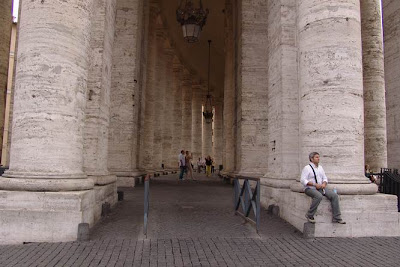 I’d love to know what someone like Roberto Paris might think about this. At this time Roberto is in the middle of a 10 day meditation retreat in India. I reckon it probably isn’t high on his punch list right now. But the clarity of his mind, after ten days, yes, I’d like to know his thoughts.
 Eight years ago, I spent several weeks in Pantelleria. I had once been invited to the island in 1971 but never made the trip. In 2001 I finally made it. I rented a dammuso, one of the thick stone houses that characterize the island. I had a motor scooter and a supply of wine from a friend who had a winery there. My wife had died a few months before and I was verklempt from the battle she waged for three years and the ultimate loss. She had the real MS, multiple sclerosis. I cannot tell you how much I despise that disease. More than anything.
 I had wine to drink and a little kitchen to cook in. I spent the days tooling around the island looking at the vineyards and other natural sights. In all, it was as good a way of mourning Liz’s loss as I could muster. There was a funeral on the island when I was there; a young person had lost their life in the sea. We were all sad that day.


 In the wine and food business we are a little like social anthropologists. There is something about the search for the best pizza, the ripest peaches, the home cured salumi and the perfect little café in the neighborhood. When it really gets down to it, the fancy wine list and the latest trend, from molecular gastronomy to collision cuisine, what I really want is a great bowl of pasta with a bottle of wine that I can enjoy and afford to drink regularly.
 So where are we going? Everywhere you look, you see the words local and sustainable and organic and artisanal. Good ideas that have become buzz words to bandy about in building a brand that has no center. What good is it to get grass fed beef if the line cook over salts it? Organic peaches that find themselves in a perverse ménage à trois with blood oranges and jalapeno chutney? Why?
 Talking with a couple of food journalists recently and the idea of the young chef came up. And the question was, “Does the young chef have anything to say with their food if they haven’t gotten enough life experience to be interesting with their creations?” Dining out wasn’t intended to be a reality show (unless it’s Hell’s Kitchen). The little CAFÉ sign I found on the street at midnight in Old East Dallas, oh how I would have loved to go back in time and see what was going on in that kitchen. This time, culinary archeology. And I find in the conversations around the table with friends, here and in Italy, we are looking for that wonderful Carbonara, that simply perfect Margherita, the espresso that one finds so easily in gas stations in Italy. Why is it so darn hard?
 Wine lists. Working with several clients over the last few weeks, and really finding some very different opinions. But more and more I am seeing restaurant people rethinking the way they serve wine in their places. Less popular is buying a wine for $17 and reselling it for $65. The wave I have been seeing, in Houston, in Dallas and Austin, is that same wine on a blackboard for $39. You know at $39 a party of four will buy two bottles. At $65 they might nurse that bottle of wine. So the establishment sells one bottle and had $48 in gross profit. Selling two bottle for $39 and they have $44 to work with. A smaller profit? Yes. A happier clientele? Most assuredly. And most likely to return sooner. This is a wave that is coming from San Francisco, from Southern California, New York, and Texas is right there, too, with these ideas. This is exciting stuff for the wine producers back in Italy who have a storeroom full of wine right now.
 Maybe that young couple who bought beer with their pizza or took it to-go to have with their Chianti at home can now have a reason to sit down in their neighborhood café and have wine instead of beer, dine-out instead of take-out. Maybe dining out might just come back in.
 To celebrate the end of May, which was an hellacious month for the wine world, Paul and Annette DiCarlo graciously opened up their home in East Dallas for a Sunday afternoon of eating and drinking. Summer is bearing down upon us, a time which we find ourselves embroiled in heat and heated debate about almost anything. Tempers flare, lines are drawn in the sand, swords are sharpened, clocks are set. But not before one last meal. One last great meal.
 We get there in time for a round of sparkling rose wine from the Veneto, all the rage now that they have saturated the market with Prosecco. I brought a bottle of Gruner just to be a contrarian. I figured after I blasted it in the last post, and some of the somms were chiding me for hating on the Gruner. Actually I like Gruner. And Zweigelt. But that’s another post.
 Major Domo Adelmo was modeling his newly acquired seersucker shorts, which showed off his tanned and muscle-bound legs, gained from his early morning walks (stalks?) in the neighborhood. Adelmo is irreverent to anything that has been established as a custom. Wine in a wine glass? Why? When it is so much more fun to pour a rare Casa dei Bepi Amarone in a jelly glass? It was Sunday, these restaurant owners work, work, work all the time. Son of a gun never rests. Let him be.
 The room was getting crowded what with the short ribs and the foie gras and the pasta course all heating up the kitchen, which is where everyone was congregating. The AC unit was on overload, set at 60. The room felt like 80+. Seersucker was a good idea, after all.
 So after the foie gras apps and all the other salumi scattered around the room, we head straight into the pasta course, some funny looking maccherone with those wonderful baby tomatoes from the south. Simple and good food. Great with the Valpolicella lined up in pole position, waiting for their moment. Also waiting for those Amarones to chill down a little, nestled in the fridge with the dessert wine and the Dublin Dr. Pepper (after all, we are in Texas).
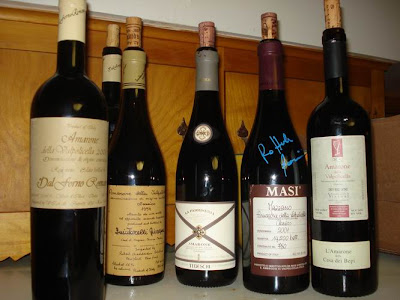 About the Amarones: Quintarelli '97 and '98, Dal Forno '01, Tedeschi '03, Masi '01, Viviani 'Casa dei Bepi' '01.
 The 2001 Viviani “Casa dei Bepi” was among my faves. Maybe because the folks are familiar. But the wine had nice body, solid flavors, some elegance, the wood was subdued (thank God) and it complimented the food. Deelish.
 And the twin vintages of Quintarelli, the ’97 and ’98. Now that was the moment of meditation for me. Everybody loves the ’97, the fruit, the power, the big balls. I get it. Or rather, I don’t get it for me. It was all that and a bag of chips, but the wine of the night, for me, was the 1998 from Quintarelli.

